Jabreen Castle
Jabreen Castle
Built in the 17th century by Imam Bil'arab, Jabreen Castle is one of Oman's best-preserved fortified palaces, celebrated for its painted ceilings and impressive reception halls.
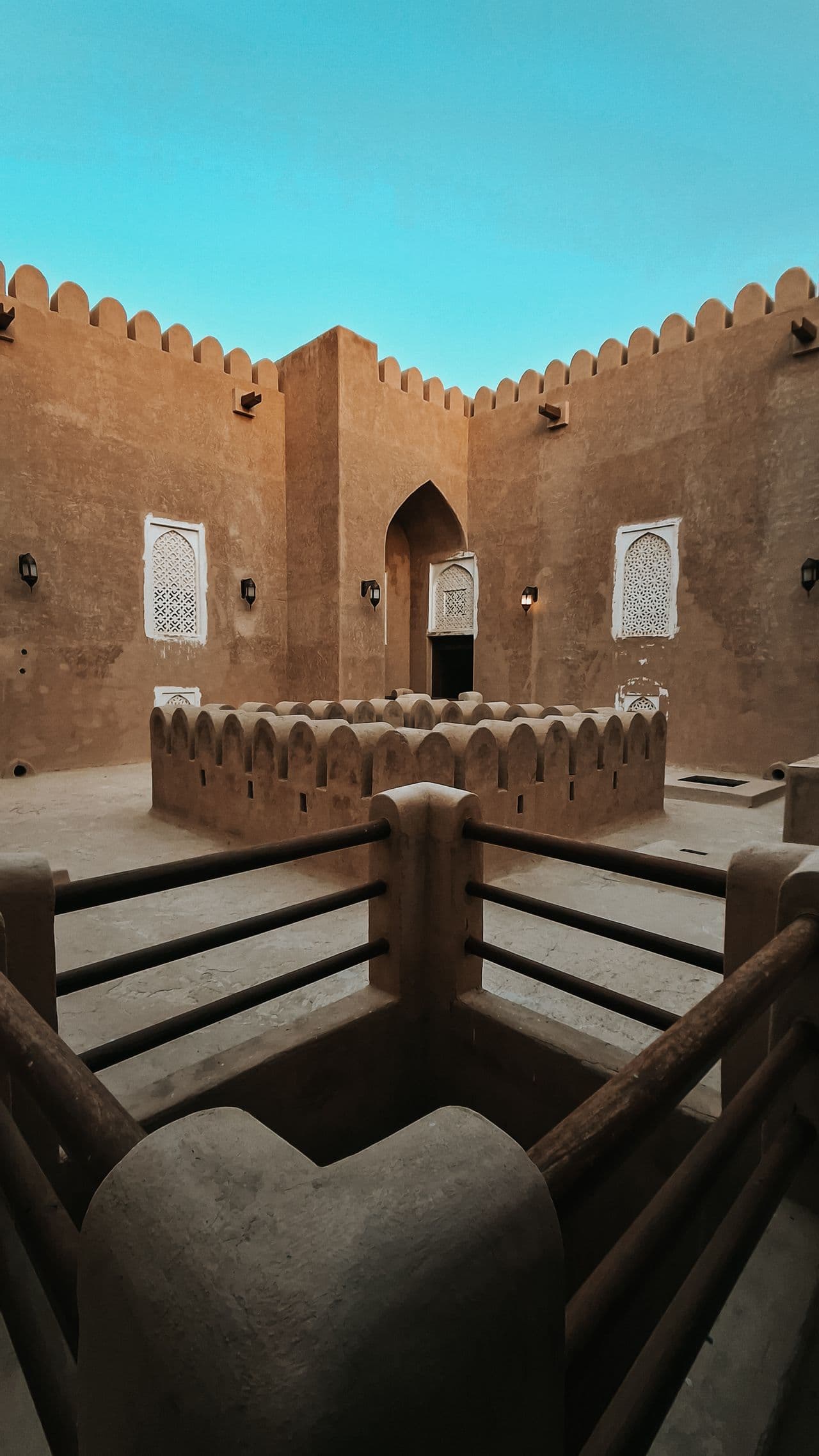
Jabreen Castle stands some twenty kilometres south-west of Bahla, in Oman's interior. Built in the 17th century, it is considered one of the country's finest preserved fortified palaces. Its painted ceilings, state rooms and interior wells bear rare witness to the civil and military architecture of the Ya'aruba period. The site is designated a national monument and managed by the Omani Ministry of Heritage.
Practical information at a glance
- Admission: paid entrance (modest fee, paid on site)
- Dress code: smart dress required; shoulders and knees covered recommended
- Suggested duration: 1 hour 30 minutes to 2 hours to explore all levels
- Access: private car or organised tour from Nizwa; no regular public transport
- Accessibility: limited — narrow stairs and uneven floors throughout most of the route
What you'll see
The castle rises over three main levels. The ground floor houses former stables and stores. The upper floors reveal reception rooms, a justice hall, private apartments and a Quranic school. The painted wooden ceilings — featuring floral motifs, calligraphy and symbolic scenes — are the highlight of any visit. Wells built within the castle walls themselves provided water independence in the event of siege.
History and context
Jabreen was built around 1675 under Imam Bil'arab ibn Sultan Al Ya'aruba, who made it both his residence and an intellectual centre. Unlike purely defensive fortresses, the castle incorporates spaces dedicated to learning and the arts. After Bil'arab's death in 1692, the building served as a mausoleum: his tomb remains visible inside. Restored in the 20th century, it reopened to the public in remarkable condition.
Highlights of the visit
The painted ceilings
Each room features different decoration. Natural pigments — ochre, indigo, green — have survived three centuries of humidity and heat. Take time to look up in every room: details vary from panel to panel.
The justice hall and the imam's apartments
The layout of the rooms illustrates the dual function of the place: governing and studying. The justice hall retains its wall niches and latticed stucco windows, which filtered light while preserving privacy.
The rooftop terrace
From the top, views sweep across the palm groves of the Bahla plain and, on clear days, the foothills of Jebel Akhdar. It's also the ideal spot to understand the site's defensive logic: firing positions, corner towers, dry moat.
The tomb of Bil'arab
Built into the castle itself, the mausoleum of the founding imam is austere and contemplative. It reminds us that Jabreen was not merely a military palace, but also a place of dynastic memory.
Etiquette and visiting rules
- Cover shoulders and knees before entering.
- Speak quietly near Bil'arab's tomb.
- Do not touch the wall paintings or woodwork.
- Photography is generally permitted, but check signage on site for restricted areas.
Photography tips
Natural light enters through small openings: mid-morning is ideal for photographing the painted ceilings without glare. For exteriors, early afternoon casts a golden light on the limestone towers. A lightweight tripod is useful in darker rooms. Avoid using flash on the paintings.
Location and access
Jabreen lies approximately 45 km south-west of Nizwa and some twenty kilometres from Bahla. An asphalt road leads directly to the foot of the castle. Most visitors combine Jabreen with Bahla and Nizwa in a single day circuit from Muscat (about 2 hours 30 minutes' drive). No regular buses serve the site; a rental car or organised tour is necessary.
In the area
- Bahla Fort — UNESCO-listed medieval fortress, twenty kilometres away; one of Oman's largest fortified enclosures.
- Nizwa — former capital, famous for its circular fort and souks of spices and crafts.
- Jebel Akhdar — mountainous plateau to the east, known for its Damask rose terraces and perched villages.
- Tanuf Ruins — abandoned village after 1950s bombing, in a spectacular gorge near Nizwa.
Frequently asked questions
From October to March, temperatures in Oman's interior remain pleasant (15-28°C). In summer, heat often exceeds 40°C outside, but the interior of the castle stays relatively cool thanks to the thickness of the walls.
Yes, this is the classic circuit from Nizwa. Allow a full day: Nizwa in the morning, Bahla in early afternoon, Jabreen in late afternoon to catch the golden light on the towers.
Generally, yes. Certain areas — particularly near the tomb — may be subject to restrictions displayed on site. Respect the signage and avoid using flash on the paintings.
Accessibility is very limited. Stairs are narrow and floors uneven throughout virtually the entire interior route. The outer courtyard remains accessible, but the upper levels are not.
Smart dress is required: shoulders and knees covered for both men and women. Bring shoes that are easy to remove if requested at the entrance to certain rooms.
Keepers present on site can provide basic explanations. For an in-depth visit, it is best to book an English-speaking guide through a local agency before your departure.
Interested in this visit?
We can include it in your personalised itinerary.