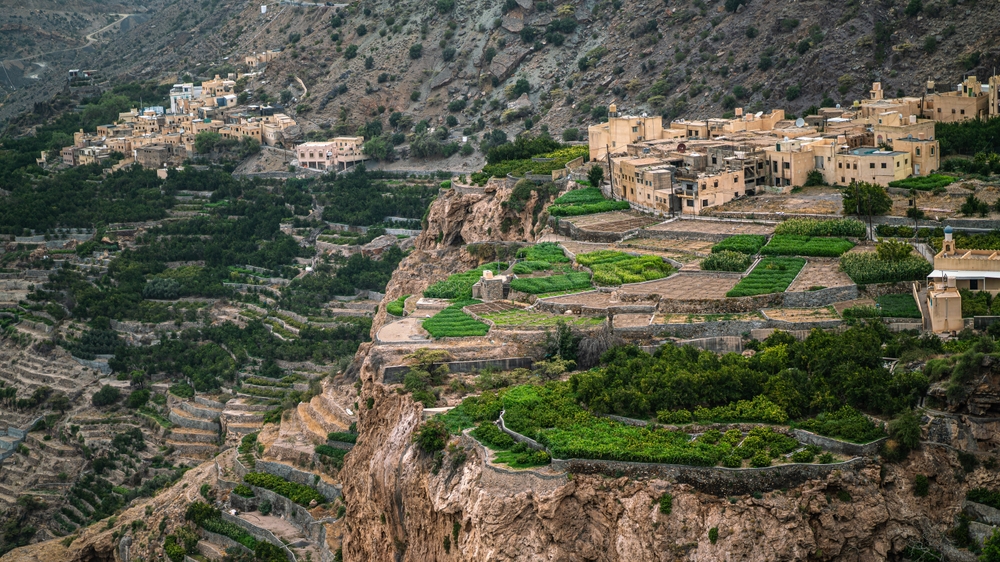
Misfah Al Abriyeen
Clinging to the flanks of Djebel Akhdar, Misfah Al Abriyeen preserves its stone architecture, its terraced gardens and its ancient falaj system—a UNESCO-listed heritage—a living village of the Omani interior.
Perched on the slopes of Djebel Akhdar, Misfah Al Abriyeen is a preserved Omani mountain village, built in stone and mud-brick at over 1,000 metres altitude. Its sheer cliffs, its date palm terraces and its ancestral irrigation network—the falaj—make it one of the rare villages where the traditional life of the Omani interior remains legible in the very landscape.
Practical information at a glance
- Access: paved road from Bahla or Al Hamra; a 4×4 is recommended for secondary tracks in the area.
- Recommended duration: 1 to 2 hours for a visit to the village and falaj.
- Dress code: shoulders and knees covered, out of respect for residents.
- Entrance: the village is freely accessible; a local guesthouse offers accommodation.
What to see
The village consists of brown stone houses clustered tightly together, connected by narrow, shaded alleyways. The falaj—an irrigation canal listed as UNESCO world heritage—winds between gardens of date palms, lemon and banana trees. The terraced fields below offer a striking contrast with the ochre rock faces that dominate the site.
History and context
Misfah Al Abriyeen has been inhabited for several centuries. Its falaj system, common to many villages in the Omani interior, testifies to hydraulic mastery developed long before the modern era. The village long lived in near self-sufficiency thanks to its irrigated gardens, isolated by the topography of Djebel Akhdar. Today it remains partially inhabited by families of the Al Abriyeen tribe.
Highlights of the visit
The falaj and gardens
Following the open-air canal from its source to the cultivated plots allows you to understand concretely how this ancient system works. Water circulates by gravity, distributed according to a strict communal timetable among families.
The alleyways and architecture
Stone and mud-brick houses, some abandoned, others still inhabited, form a cohesive architectural ensemble. The carved wooden doors, typical of the Omani interior, deserve careful attention.
The panorama over the valley
From the heights of the village, the view sweeps down over the Al Hamra palm groves and the reliefs of Djebel Akhdar. Late afternoon light accentuates the contrasts between rock, verdure and sky.
Etiquette and visiting rules
- Misfah is an inhabited village: adopt discreet and respectful behaviour.
- Ask permission before photographing residents, particularly women.
- Do not enter private properties without invitation.
- Avoid disturbing the falaj or cultivated gardens.
Photography tips
Golden morning light illuminates the stone facades from the east and reveals the texture of the buildings. In late afternoon, the palm terraces capture ideal warm light. Reflections in the falaj channels offer original framing opportunities. Avoid midday, which is too contrasty for the shaded alleyways.
Location and access
Misfah Al Abriyeen is located in the Al Dakhiliyah region, a few kilometres north-west of Al Hamra. The town of Bahla, listed as world heritage, is accessible in less than an hour. Nizwa, the regional capital with its fort and souk, is the natural logistics base for visiting this area. The road is passable in a standard car to the village; a 4×4 opens access to surrounding tracks.
Nearby
- Al Hamra — ancient town with multi-storey mud-brick houses, the usual departure point for Misfah.
- Bahla Fort — medieval fortress listed by UNESCO, less than an hour away.
- Nizwa — 17th-century fort and souk with pottery and khanjars, the essential regional centre.
- Djebel Akhdar — mountain plateau with rose gardens and hiking, accessible from the same road.
Frequently asked questions
From October to April, temperatures at altitude remain pleasant. Summer (June-August) is hot but more bearable than on the plains thanks to the altitude.
The main road to Misfah is paved and passable in a standard car. A 4×4 is useful only for exploring secondary tracks in the surrounding Djebel area.
A local guesthouse offers rooms in the village, allowing you to enjoy the site early in the morning or in the evening, outside tourist visiting hours.
Yes. Al Hamra, Bahla and Nizwa are all less than an hour away. A day trip from Nizwa allows you to comfortably visit all three sites.
Access to the village and falaj is free. Only accommodation at the guesthouse is charged.
The landscape, architecture and falaj can be freely photographed. For residents, always ask permission beforehand.
Want to discover this destination?
Our local advisors design your tailor-made trip.