Mughsail Beach
Mughsail Beach
West of Salalah, Mughsail Beach is renowned for its natural blowholes that project seawater in geysers through rocky fissures, particularly active during the khareef monsoon season.
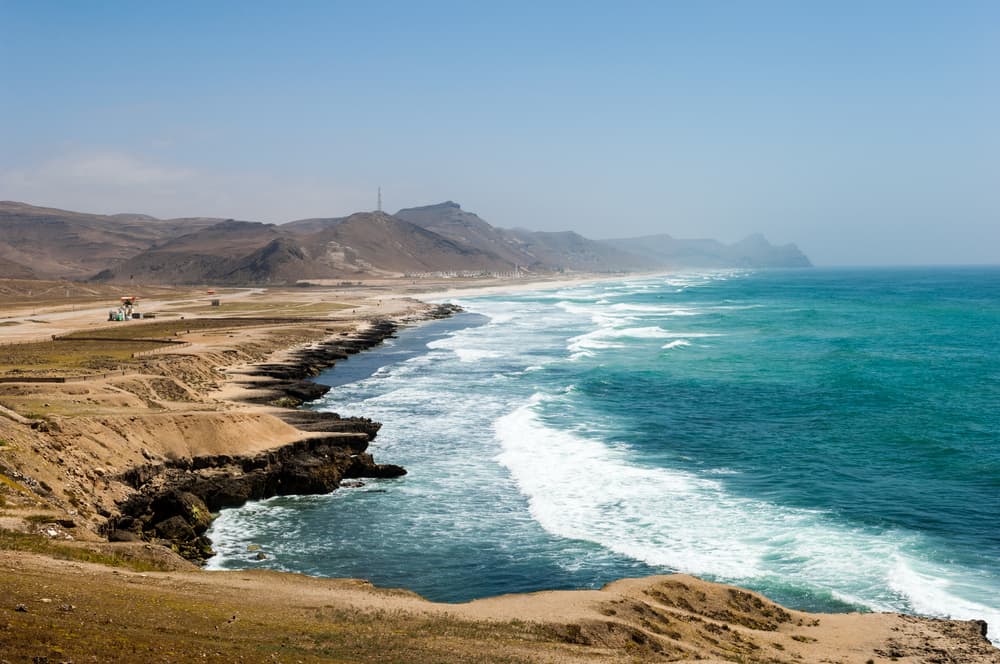
About thirty kilometers west of Salalah, Mughsail Beach stretches for several kilometers of white sand bordered by limestone cliffs. The site is best known for its blowholes: natural fissures in the rock through which seawater shoots up in spectacular geysers, particularly active during the Dhofar monsoon season, known as khareef (June–September). The arid hinterland contrasts sharply with the lush vegetation of the rainy season, creating a landscape rarely seen in Arabia.
Practical Information at a Glance
- Entry: free and open access to the beach and blowholes
- Suggested duration: 1 to 2 hours
- Best time to visit: khareef (June–September) for the blowholes at their peak; off-season for swimming and tranquility
- Swimming: not recommended during monsoon season due to powerful waves and strong currents
- Access: paved road from Salalah (coastal road heading west); parking available on-site
- Attire: appropriate beach clothing recommended; respect local customs
What to See
The beach itself is long and relatively uncrowded outside peak season, with pale sand and turquoise waters. The blowholes are the main attraction: positioned on the rocky platform at the beach's far end, they propel water several meters into the air when waves surge into underwater cavities. Signage marks the viewing area.
In the background, the cliffs of Jebel Qamar drop toward the sea. During khareef, verdant vegetation covering these heights creates a striking contrast with the Indian Ocean's blue waters.
History and Context
Mughsail lies in the Dhofar region, historically tied to the frankincense trade. The coast long served as a passage point for Arabic dhows connecting Oman with East Africa and India. The natural site itself has been shaped by marine erosion of Jebel Qamar's limestone, a process that carved the tunnels responsible for the blowholes.
Highlights of Your Visit
The Blowholes in Action
During monsoon season, each significant wave triggers impressive water jets. The rocky platform is accessible on foot from the parking area. Remain behind barriers: the projections can be sudden and forceful.
The Beach Off-Season
From October to May, the sea is calm and the beach nearly deserted. Clear waters allow observation of the seafloor from the shore. This is the ideal period for a peaceful stop on the road toward the Yemeni border.
The Clifftop Panorama
A pathway runs along the cliff edge above the beach, offering sweeping views of the entire coastline and the limestone strata of Jebel Qamar. Visit early morning to avoid the heat.
Photography Tips
Blowholes photograph best in morning light or late afternoon, when the sun is low and illuminates the water jets from the side. Use a fast shutter speed to freeze the sprays. For cliffs and beach views, sunset casts warm tones across the white limestone. Protect your equipment from sea spray in the blowholes area.
Location and Access
Mughsail is approximately 35 km west of Salalah, accessible via the coastal road (Route 47). The road is in good condition and scenic. There is no regular public transportation to the site; car rental from Salalah is the most practical solution. Parking is spacious and free. The terrain around the blowholes is flat and paved, largely accessible for people with reduced mobility.
Nearby Attractions
- Salalah and Dhofar — the coastal city offers souks, beaches, and the Al-Husn frankincense market.
- Wadi Darbat — lush wadi with waterfalls during khareef, east of Salalah.
- Ayn Razat — natural spring surrounded by gardens, a popular picnic spot for Omani families.
- Khor Rori (Sumhuram) — archaeological site of the ancient city of Sumhuram, inscribed on the UNESCO World Heritage List.
Frequently asked questions
The Dhofar monsoon, called khareef, runs from June to September. During this period, waves are strongest and the blowholes are most active. Outside this season, the effect is noticeably less dramatic.
Swimming is not recommended during khareef due to strong currents and powerful waves. From October to May, the sea is calmer and swimming is possible, but check local conditions before entering the water.
No, access to the beach and blowholes area is completely free. Parking on-site is also complimentary.
Car rental is the most convenient option. The coastal road heading west from Salalah leads directly to the site. There is no regular bus service to Mughsail.
Yes. A day trip from Salalah allows you to visit Mughsail in the morning, then return via Wadi Darbat or Khor Rori to the east of the city. The coastal road itself is very scenic.
No known restrictions on photography at this public natural site. Simply protect your equipment from sea spray in the blowholes area.
Interested in this visit?
We can include it in your personalised itinerary.